
You drop the car off expecting a clean tick. An hour later you're holding a rejection sheet with five items on it, a repair quote that's blown your sale margin to bits, and a fortnight to get it sorted before you start over. That conversation should have happened before the test, not after.
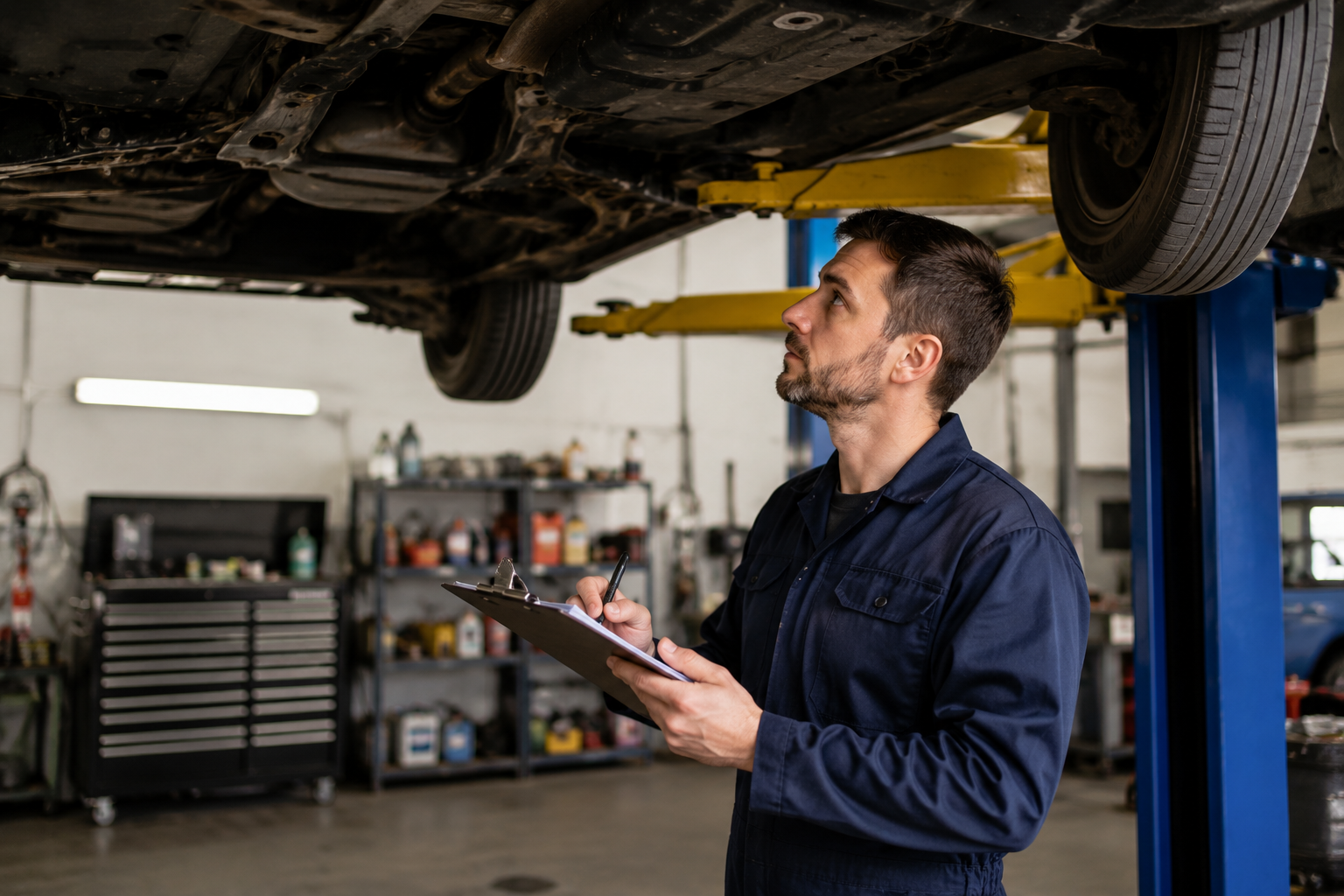
A roadworthy certificate (RWC) in Victoria is a safety check, not a mechanical health report. The licensed vehicle tester works from Vehicle Standards Information 26 (VSI 26), the document that tells testers exactly what to assess and what counts as a fail. Knowing what those checks look for, and what each fix usually costs, lets you plan the sale instead of reacting to a list you weren't expecting.
Below is a reference table covering the eight categories that account for most RWC fails in Victoria, followed by what the tester is looking at in each one and where most cars come unstuck.
| Failure category | What the tester checks | Typical fix range |
|---|---|---|
| Tyres | Tread depth (minimum 1.5 mm), sidewall damage, correct sizing | $150–$400 per axle |
| Brake pads and rotors | Pad thickness, rotor thickness, scoring, stopping performance | $300–$700 per axle |
| Suspension and steering | Ball joints, tie rod ends, bushes, shocks, steering play | $300–$1,500 |
| Lights | All globes working, lens condition, headlight beam aim | $30–$200 |
| Windscreen and wipers | Cracks in the driver's line of sight, wiper performance | $150–$1,000+ |
| Seatbelts | Retraction, locking under load, webbing condition | $120–$400 |
| Exhaust | Leaks, holes, loose mounts, catalytic converter, noise | $200–$900 |
| Parking brake | Holds the vehicle on a gradient, cable adjustment | $150–$500 |
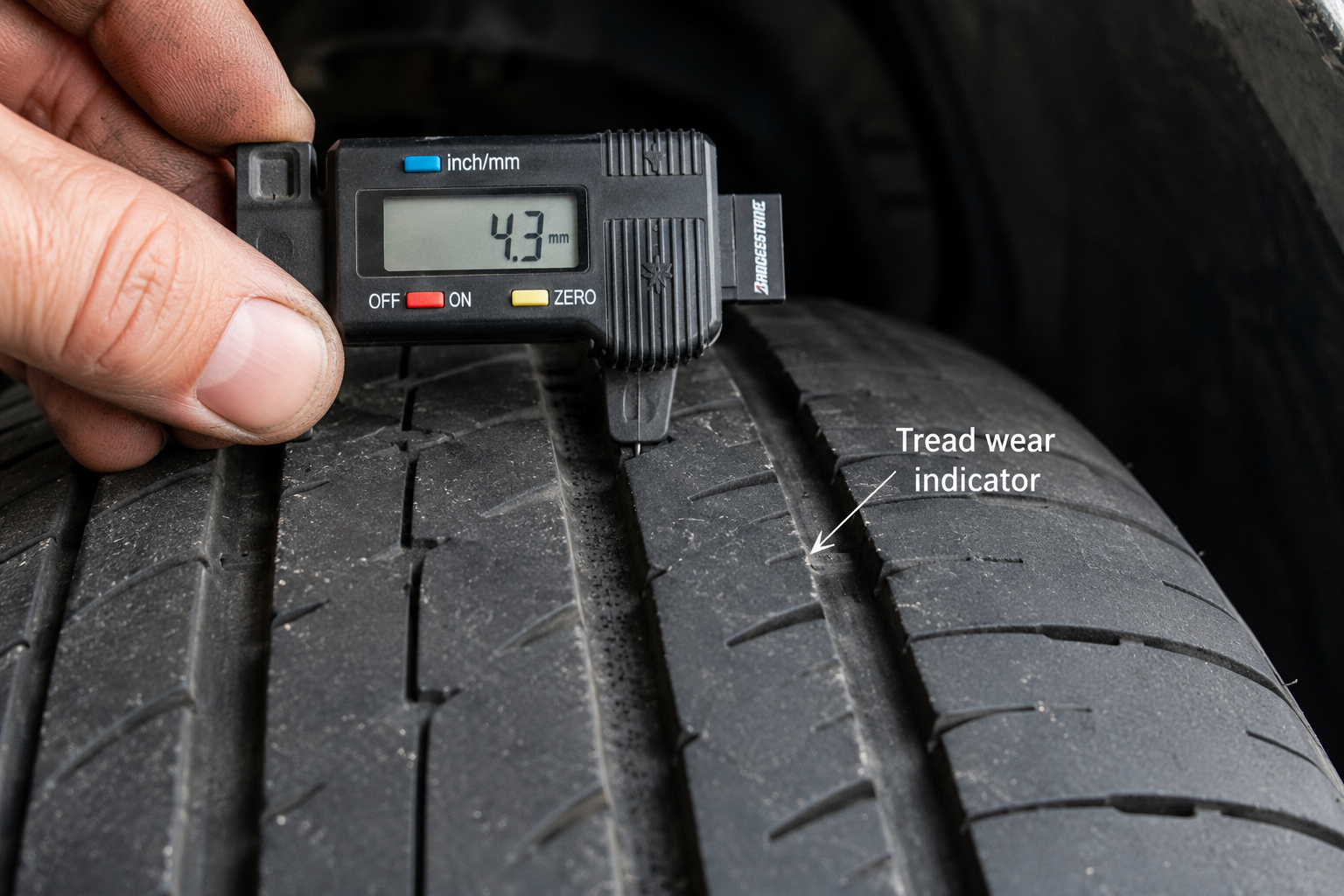
The legal minimum tread depth in Victoria is 1.5 mm across all principal grooves. The catch is that the tester checks the worst-worn point on each tyre, not the average across the tread. A tyre that looks fine to a casual eye can still fail if the inside shoulder is worn through, common on cars with a misaligned camber that haven't had a wheel alignment in years.
Beyond tread depth, the tester also fails tyres for:
Brakes are the most safety-critical category and the one testers spend the most time on. The four things they're looking at:
Second cars and cars left sitting through Melbourne winters often fail on rust pitting across the rotor faces, even with plenty of pad material remaining.
This category covers ball joints, tie rod ends, control arm bushes, shock absorbers, and the steering rack. The tester checks for play in the joints (any unwanted free movement), leaks from the shocks, and excessive give in the rubber bushes. Failures usually come as a cluster: if one ball joint is shot, the tie rods on the same side often aren't far behind. Cars over 150,000 km on original suspension components are common candidates. Bushes are the cheapest item to replace; ball joints and shocks are where the bill climbs.
The simplest category to check yourself before you book. Every globe has to work and every lens has to be clear. The tester runs through:
Walk around the car with the lights on before you book, with someone pressing the brake pedal from the driver's seat. Half the lights fails get caught in the driveway.
Cracks or chips in the driver's primary line of sight are a fail. The boundary is roughly the area swept by the driver's-side wiper. Small chips outside that zone usually pass; the same chip 200 mm to the right will not. Wiper blades that smear, streak, or chatter across the glass also fail. A stone chip that's spread into a long crack typically needs a full windscreen replacement rather than a chip repair, and the cost difference between the two outcomes is significant.
Every fitted seatbelt has to retract properly, lock under load when you pull it sharply, and show no fraying, cuts, or melt damage on the webbing. The buckle also has to release cleanly and re-engage with a positive click. Older family cars often fail on retractor sluggishness, where the belt won't pull back into the housing on its own. The belt itself can't usually be repaired. The whole assembly has to be replaced.
The tester listens for leaks and looks underneath for visible damage. The fail items:
Split flexi joints are one of the more common failures in this category, especially on front-wheel-drive cars where the flexi takes the strain every time the engine torques against the mount.
The parking brake has to hold the vehicle stationary on a defined gradient. The tester applies the handbrake, attempts to drive against it, and watches whether the car holds. Cable stretch is the usual culprit on older cars: the lever pulls all the way up but the brake won't hold the car on a slope. On cars with an electronic parking brake, a fault code or a worn rear pad assembly is the more likely cause, and the fix is more involved.
An RWC isn't a full mechanical inspection, and that catches both buyers and sellers out. The tester doesn't assess:
A car can pass an RWC on Monday and need a $4,000 transmission rebuild on Friday. If you're buying, a proper pre-purchase inspection is a separate job worth paying for on top of the RWC.
If the car fails, the tester gives you a rejection report listing every fail item. From the date on that report, you have 14 days to fix the items and bring the car back to the same tester. Inside the 14 days, the tester only re-checks the failed items rather than running a full new inspection. You pay for the re-check, not the whole test again. Miss the window, and you're back to a full inspection from scratch.
The catch most people miss: the 14-day clock starts at the first inspection, not when the repairs begin. If the car fails on a Friday afternoon and the parts won't arrive until the following Wednesday, five days are already gone. A pre-RWC check at a workshop before the official test gets the fixes done before the clock ever starts ticking.
The hard call comes when the rejection list outweighs what the car is worth. A 2008 Commodore worth $4,500 with $3,200 of fails (tyres, control arms, exhaust, windscreen) usually isn't worth saving for a private sale. Selling unregistered as-is, or to a wrecker, sometimes nets more than fixing the car for full RWC.
A rough rule of thumb: if the repair list runs more than 30 to 40% of the car's market value, run the numbers carefully before greenlighting the work. Older cars often hide a second wave of issues an RWC won't catch. Worn engine mounts, a tired transmission, a cooling system on borrowed time. Cumulative repair cost rarely stops at the rejection list, and the older the car, the more likely you'll be paying for the next round before you've recovered the first.
A pre-RWC inspection at a workshop, not the official test but a check against the same VSI 26 standards, is the cheapest insurance against a surprise fail list. We put the car on the hoist, work through the standards, and tell you exactly what would fail and roughly what each fix will cost. From there you can decide whether to repair, walk away from the sale, or sell as-is. No 14-day clock, no scramble.
If you're in Rowville, Knoxfield, Lysterfield, Scoresby, or Wantirna South and you're getting ready to list a car for sale, book a pre-RWC inspection with us first. Free local pick-up and drop-off if you can't get the car to the workshop yourself.

